

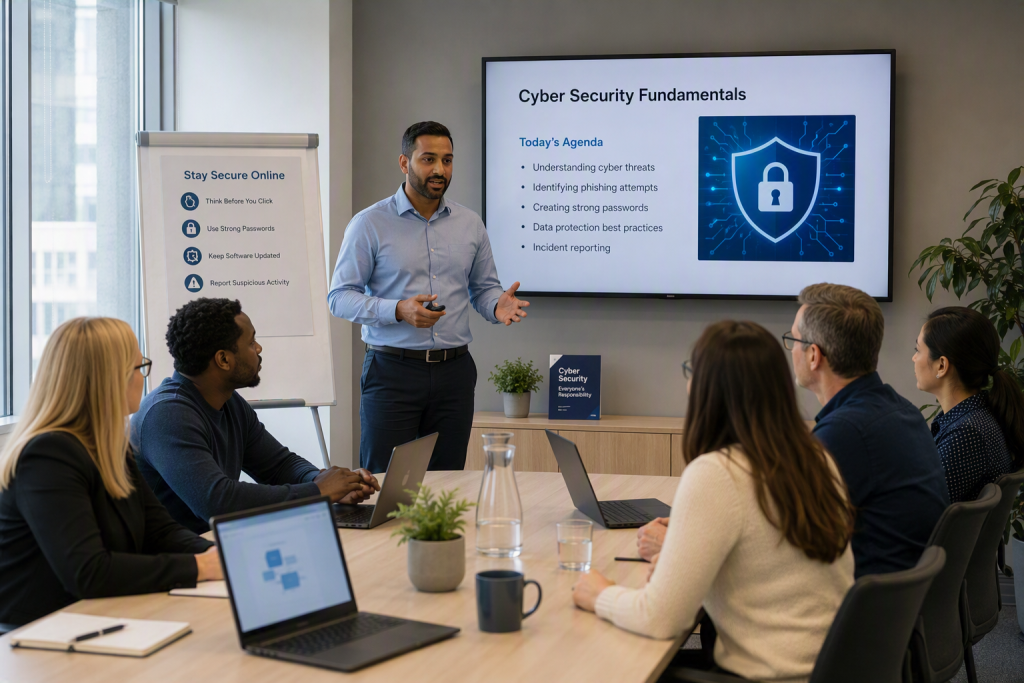
Cybersecurity is often viewed as an IT responsibility, but the reality is far broader. Modern cyber attacks increasingly target people, not just technology. While businesses invest heavily in firewalls, endpoint protection, and advanced security solutions, cyber criminals continue to exploit the easiest route into an organisation: its employees.
For businesses that rely on outsourced IT support, a comprehensive cybersecurity strategy must combine technology with education. Employees who understand cyber risks can identify threats before they become incidents, helping to protect data, maintain operations, and preserve customer trust.
Good cyber awareness training is no longer a nice-to-have. It is an essential part of doing business safely in today’s digital world.
Your Employees Are Your First Line of Defence
Many cyber attacks begin with a simple human interaction. A phishing email, fraudulent invoice, malicious attachment, or convincing phone call can all provide criminals with the access they need.
Even the most sophisticated security systems cannot eliminate every threat. Attackers understand this and increasingly focus on manipulating people rather than trying to bypass technical controls.
Cyber awareness training helps employees:
When employees know what to look for, they become an active part of your organisation’s security strategy.
Need Advice on Microsoft 365 Security?
Get free insights into the health of your IT estate, with no pushy sales, and no obligation to sign up.
Phishing Attacks Are More Sophisticated Than Ever
Today’s phishing attacks are far more convincing than the poorly written scam emails of the past. Cyber criminals now use publicly available information, social media profiles, and artificial intelligence tools to create highly personalised messages.
Attackers commonly impersonate:
Employees should be trained to recognise warning signs such as:
Modern phishing campaigns are specifically designed to appear legitimate. Regular training ensures employees remain alert to these evolving tactics.
Reducing Downtime and Financial Loss
A successful cyber attack can disrupt business operations for days or even weeks.
Whether caused by ransomware, account compromise, or data theft, the impact often extends far beyond the initial incident. Businesses can face:
Preventing even one incident can save an organisation significant time and money. Cyber awareness training reduces risk by helping employees avoid the mistakes that attackers depend upon.
Protecting Customer Trust and Company Reputation
Trust is one of the most valuable assets any business possesses.
Customers expect organisations to protect personal information, financial data, contracts, and confidential communications. A security breach can undermine confidence and damage relationships that have taken years to build.
Effective awareness training helps employees understand:
A security-conscious workforce demonstrates a clear commitment to protecting both business and customer data.
Supporting Compliance and Regulatory Requirements
Many organisations operate within regulatory frameworks that require appropriate security controls and staff training.
For UK businesses, regulations such as UK GDPR place a responsibility on organisations to take reasonable measures to protect personal information. Employee awareness and training form a key part of demonstrating compliance.
Regular cybersecurity training can help organisations:
Compliance should not be viewed as a tick-box exercise. Instead, it should be part of a broader effort to protect the organisation from avoidable risks.
Cybersecurity Requires Continuous Learning
Cyber threats evolve constantly.
New phishing techniques, AI-generated scams, and social engineering tactics emerge every year. A single annual training session is no longer sufficient to keep employees prepared.
The most effective awareness programmes include:
Continuous education helps ensure cybersecurity remains part of everyday decision-making rather than something employees think about only occasionally.
How Managed IT Support Providers Help
A trusted outsourced IT support provider delivers much more than technical support.
Many managed service providers help businesses strengthen cyber resilience by combining advanced security technologies with employee education.
Services often include:
By addressing both the human and technical aspects of cybersecurity, businesses gain multiple layers of protection against modern threats.
What This Means for Your Business
Cybersecurity is no longer solely about protecting devices and networks. It is about empowering your people to make informed decisions when they encounter potential threats.
Investing in cyber awareness training can significantly reduce risk, minimise business disruption, improve compliance, and protect customer trust. Combined with professional IT support and strong technical controls, it forms a critical part of a modern cybersecurity strategy.
Businesses that treat cybersecurity as a shared responsibility are often far better positioned to withstand the growing range of cyber threats facing organisations today.
Need Help Strengthening Your Cybersecurity Strategy?
If you’d like to improve your organisation’s cyber resilience, our team can help. We provide practical cyber awareness training, phishing simulations, and managed IT support designed to help businesses reduce risk and build a stronger security culture.
Get in touch to discuss how we can help protect your business, your employees, and your customers.
Want help with your IT?
Get free insights into the health of your IT estate, with no pushy sales, and no obligation to sign up.