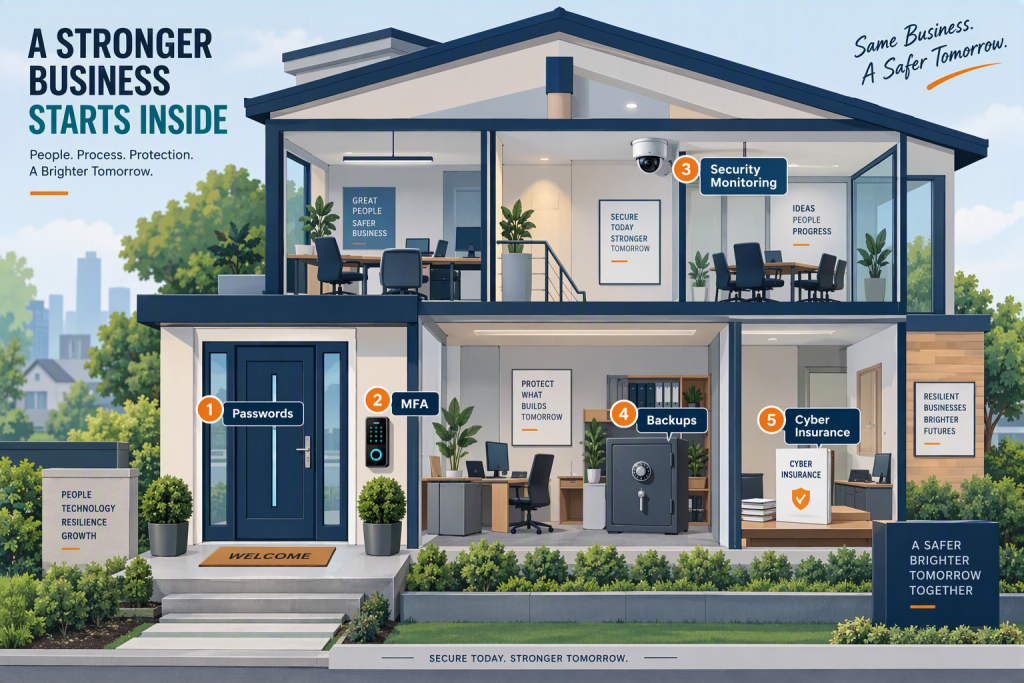
The Front Door: Passwords
Your front door controls who can enter your home. If it’s left unlocked or secured with a flimsy lock, it becomes an easy target.
Passwords serve the same purpose for your business systems. Weak or reused passwords give cybercriminals a simple way in. Once an account is compromised, attackers can gain access to emails, files, customer information, and business applications.
Strong, unique passwords remain one of the most effective ways to reduce risk. Password managers can make it easier for employees to create and securely store complex passwords without needing to remember dozens of different combinations.
Ask yourself: Would you leave the office unlocked when you go home? If not, don’t leave your business protected by weak passwords.
The Locks: Multi-Factor Authentication (MFA)
A strong front door is important, but most people prefer more than one lock.
Multi-Factor Authentication (MFA) adds an additional security layer by requiring users to provide a second form of verification, such as an authenticator app approval, security key, or one-time code.
The UK’s National Cyber Security Centre (NCSC) recommends implementing strong MFA because it significantly reduces the risk of unauthorised access, even if a password is stolen. Phishing-resistant methods such as FIDO2 security keys provide particularly strong protection against modern attacks.
Think of MFA as needing both a key and a security code before entering your house. Even if someone steals the key, they’re still locked out.
CCTV: Security Monitoring
Security cameras don’t prevent every incident, but they help you spot suspicious activity and respond quickly.
In the IT world, security monitoring provides that same visibility.
Modern monitoring tools continuously watch networks, devices, and cloud services for unusual behaviour, including:
- Unauthorised login attempts
- Suspicious file downloads
- Malware activity
- Unusual network traffic
- Potential ransomware attacks
The faster suspicious activity is detected, the quicker action can be taken to minimise disruption and damage.
Good monitoring gives businesses confidence that someone is keeping an eye on the property, even when nobody is physically there.
The Safe: Backups
Every home has items that would be difficult or impossible to replace. That’s why many people use a safe.
For businesses, those valuable assets are often data, customer records, emails, financial information, and operational systems.
No matter how strong your cybersecurity measures are, accidents happen. Hardware fails. Files get deleted. Cybercriminals deploy ransomware.
That’s where backups become essential.
Industry best practice follows the 3-2-1 backup strategy:
- Keep 3 copies of your data
- Store them on 2 different media types
- Keep 1 copy off-site or in the cloud
A backup is not designed to prevent an incident. It’s designed to ensure your business can recover when one occurs.
Insurance: Cyber Insurance
Most homeowners have insurance because they know some risks are outside their control.
Cyber insurance works in much the same way.
Even organisations with strong security controls can become victims of sophisticated attacks. Cyber insurance can help cover costs related to:
- Data breach investigations
- Legal and regulatory expenses
- Business interruption
- Recovery and remediation services
- Customer notification requirements
Insurance shouldn’t replace cybersecurity, but it can provide valuable financial protection when unexpected events occur.
Building a Secure Business Home
No homeowner relies solely on a front door for protection.
Instead, they combine multiple safeguards that work together:

Strong passwords
Multi-Factor Authentication (MFA)
Security monitoring
Reliable backups
Cyber insurance
Cybersecurity works best when it follows the same layered approach.
Recent breach investigations continue to show that stolen or misused credentials remain a significant factor in many attacks, highlighting the importance of protecting accounts and monitoring access.
Each layer serves a different purpose, helping to reduce risk while improving your ability to recover if something goes wrong.
What This Means for Your Business
Cybersecurity doesn’t need to be complicated.
By viewing your IT systems as a property that requires protection, it becomes easier to understand why multiple defences are necessary. A strong password alone isn’t enough. A backup alone isn’t enough. Security comes from combining preventative, detective, and recovery measures into a complete strategy.
The businesses that recover quickest from cyber incidents are typically those that planned ahead and layered their defences before a problem occurred.
Final Thoughts
If your business was a house, would it have sturdy doors, high-quality locks, CCTV, a secure safe, and insurance?
Or would it be vulnerable to anyone who decided to walk in?